Concord sits on Piedmont red clay, and red clay has opinions. It swells when wet, shrinks when dry, and holds water longer than sandy soil. Concrete poured over it without preparation inherits every one of those movements. Most slab failures blamed on bad concrete in this area trace back to the base: soft clay left in place, stone skipped to save time, or drainage ignored until the first big storm moved soil from under an edge.
Neglect does not usually destroy a slab in a month. It works in stages. A small void becomes a rocking corner. A rocking corner becomes a wide crack. A wide crack lets in more water, which softens more clay. Understanding that chain, and the numbers behind clay movement, helps you catch the cheap stage before it becomes the tear-out stage.
What red clay does under a slab
Clay particles are tiny and flat, so they absorb water between layers and expand. In a wet winter and spring, clay under a driveway can swell enough to lift a section. In a dry summer, the same clay shrinks and pulls away, leaving the slab bridging a gap. That cycle is hardest at edges, near downspouts, and where trees draw moisture from one side of a slab. Compaction changes the behavior. Clay and stone compacted in layers at the right moisture content move far less than loose fill dumped and leveled. That is why base preparation takes time even though none of it shows in the finished job.
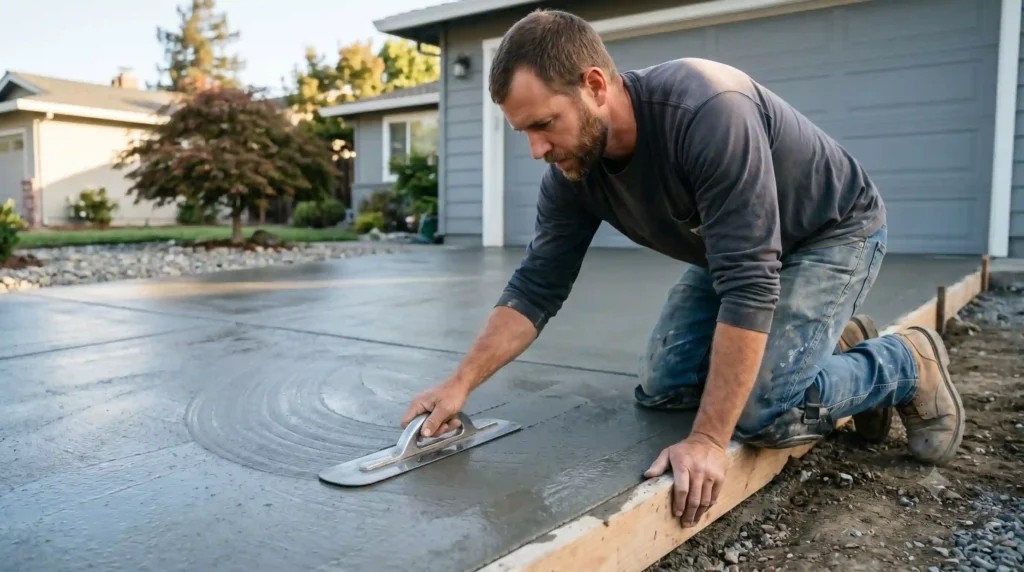
The stages of neglect, in order
Stage one is water misdirected. A downspout pours at the edge of the slab, gutters overflow in the same corner, or soil is graded toward the driveway. Stage two is washout and softening. Fine soil migrates out, clay stays wet, and support becomes uneven. Stage three is movement you can see: a corner settles, a joint opens unevenly, or a panel heaves in winter and does not fully return. Stage four is structural cracking and crumbling edges, at which point surface repairs stop working. Crews like Linker Concrete Finishing, Inc. see the same pattern across Concord subdivisions built on similar clay, and the fix at stage four is removal and a rebuilt base, not another patch.
Protecting the base you already have
You cannot change your soil, but you can manage its water. Keep downspout extensions carrying roof water well past slab edges. Maintain soil levels against the slab so edges stay supported, but never pile mulch or dirt over the surface. Seal joints where water enters against the house. Watch the low corner after summer thunderstorms, because that is where washout announces itself with a small trench or exposed edge. After a long dry spell, look for gaps opening between soil and slab. Those gaps are the shrinkage part of the cycle, and they are your early warning to fix drainage before the fall rains fill them and swell the clay again.
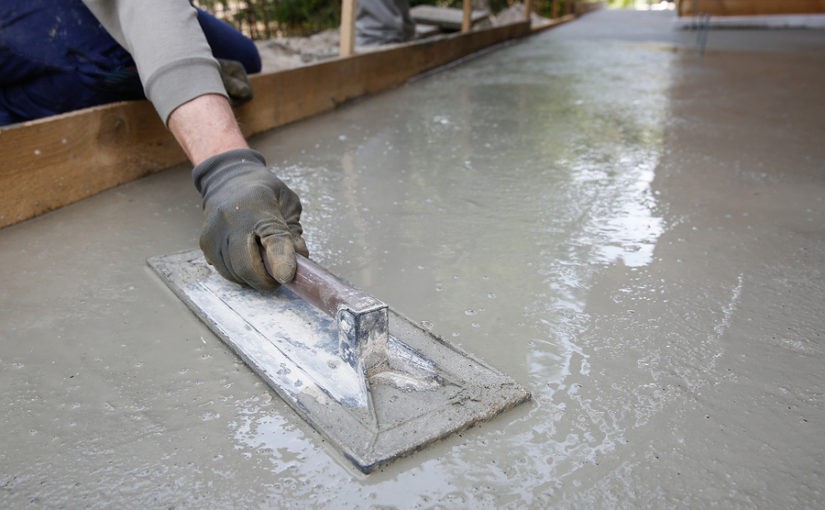
What good base preparation actually looks like
On pour day you should see stripped topsoil and soft spots removed, not buried. You should see stone spread and compacted in layers where the design calls for it, forms set to the planned slope, and reinforcement supported off the ground. The subgrade should look even and firm enough that a boot leaves only a shallow print. If rain is forecast, a good crew protects the prepared base rather than pouring over mud, because mud worked into the base undoes the compaction. Asking to see the base before the truck arrives is reasonable. Once concrete covers it, the most important part of the job is invisible, and the only record is what you and the crew documented before the pour began.
Common questions
Is red clay too poor to pour concrete on?
No. Most Piedmont slabs sit on clay and perform well when soft material is removed, the base is compacted in layers, and drainage is handled. Skipping that preparation is the problem, not the clay itself.
Why did my slab settle at one corner only?
Corners collect water from downspouts, joints, and grade all at once, so they soften and wash out first. One settled corner usually points to a local drainage problem rather than a whole slab failure.
Can a settled slab be lifted instead of replaced?
Sometimes lifting works if the slab is sound and the base problem can be addressed. If the concrete is badly cracked or the washout keeps returning, replacement with a corrected base is the more durable answer.
Photos in this guide are representative stock images.
← All guides from Linker Concrete Finishing, Inc.← Back to Linker Concrete Finishing, Inc.