Homeowners in Concord hear a lot of confident advice about concrete before a pour. Thicker is always stronger. More steel fixes everything. Fiber replaces rebar. Most of those claims contain a piece of truth and a missing condition, and the missing condition is usually the base underneath or the water in the mix. This piece sorts the common claims for driveways, patios, sidewalks, and slabs served by Linker Concrete Finishing, Inc. so you can read a proposal without needing an engineering degree.
Concrete works in compression. It resists being squeezed far better than it resists being pulled apart. Thickness, strength rating, and reinforcement each do a different job, and none of them compensates for a soft or uneven base. Once you separate those three jobs, most myths fall apart quickly.
First, the three numbers that matter
Thickness is measured in inches and sets how much load the slab can spread before it flexes. A typical residential driveway is poured at four inches, while areas that carry heavier vehicles or sit on weaker soil are often poured thicker. Strength is measured in pounds per square inch, called PSI, which describes how hard the cured concrete is. A common residential mix is around 3,000 to 4,000 PSI. Higher PSI helps with surface wear and load, but adding water on site to make the mix easier to spread lowers that strength. Reinforcement sits inside the slab to hold it together after it cracks, because all concrete cracks in small ways as it shrinks and moves.
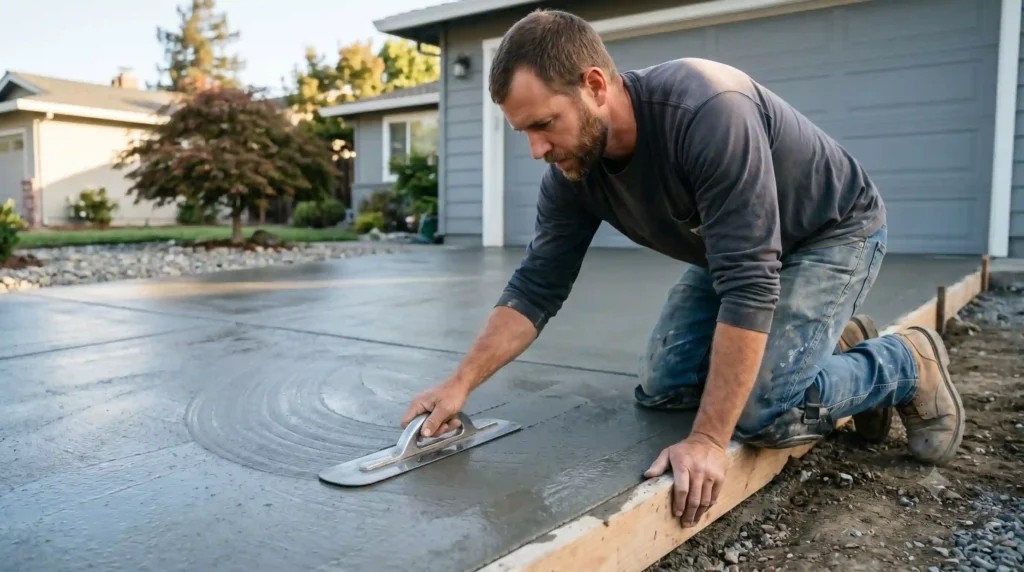
Those three ideas interact. A thick slab poured too wet can perform worse than a thinner slab poured at the right consistency on compacted stone. A strong mix placed on loose red clay will still settle. Good specs are a package, not a single bragging number.
Myth, fact, and it depends
The table below takes the claims homeowners hear most often and gives a plain verdict. Notice how many land in the middle column. That is not evasion. It reflects how much the ground, the load, and the weather on pour day change the answer.
| Claim | Verdict | What is actually true |
|---|---|---|
| Thicker is always stronger | It depends | Extra thickness helps under load, but only on a firm, even base. Thickness over soft spots still flexes and cracks. |
| Rebar makes concrete crack-proof | False | Steel holds cracks tight and keeps sections aligned. It does not prevent cracking. |
| Wire mesh and rebar are the same thing | False | Mesh is lighter and often ends up at the bottom of the slab if not lifted during the pour. Rebar on chairs stays where it was placed. |
| Fiber replaces all steel | It depends | Fiber helps control small shrinkage cracks in the surface. For driveways and structural slabs, many pours still use mesh or rebar as the main reinforcement. |
| Higher PSI fixes a weak base | False | Strength in the mix does not stop settlement. Compaction and drainage have to be right first. |
| Adding water makes the job better | False | Extra water makes placing easier and curing weaker. It raises the risk of scaling, dusting, and early cracks. |
Rebar, mesh, and fiber in plain terms
Rebar is ribbed steel rod tied into a grid. It is the strongest option and is common where vehicles turn, where the slab meets a garage, or where soil is questionable. Wire mesh is a lighter grid of welded wire. It can work well for sidewalks and patios when it is supported in the middle of the slab rather than left on the ground. Fiber is short strands mixed through the concrete itself. It is good at reducing tiny plastic shrinkage cracks that form while the surface is drying, and it leaves no metal to rust. Many residential pours combine approaches, for example fiber in the mix plus rebar at edges and transitions where stress concentrates.
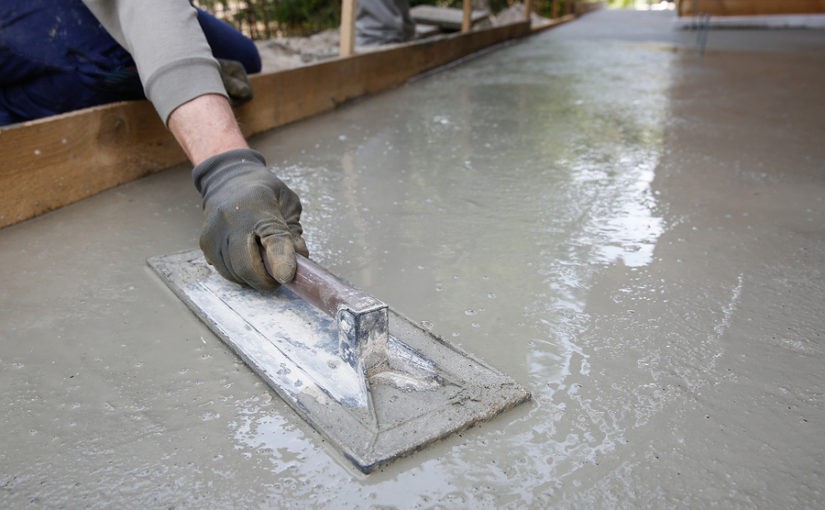
Placement matters as much as the material chosen. Steel sitting on the dirt does almost nothing. Steel floated too close to the surface can show rust marks later. Ask where the reinforcement will sit in the slab, not just whether it is included.
How to read a proposal in Concord
Look for four lines before you look at anything else: thickness in inches, PSI of the mix, type and placement of reinforcement, and what base preparation is included. Base preparation should describe removing soft material, adding and compacting stone where needed, and setting forms to drain water away from the house. If a proposal lists only square footage and a finish, the most important work is not described. Also ask about joints, because a well reinforced slab without proper joints will still crack in awkward places. In the Piedmont, summer heat speeds curing and winter cold slows it, so timing and curing method belong in the conversation too. A clear spec protects both sides: you know what you bought, and the crew knows what they promised to build.
Common questions
Is four inches thick enough for a driveway?
For most cars and light trucks on a firm base, four inches is the standard residential thickness. Heavier vehicles, turning areas, and weak soil are common reasons to go thicker.
What PSI should I ask for?
Many residential driveways and patios use a mix in the 3,000 to 4,000 PSI range. The right choice depends on load and exposure, and keeping extra water out of the mix matters as much as the number.
Do I need rebar, mesh, or fiber?
Most slabs benefit from at least one form of reinforcement. Fiber helps with small shrinkage cracks, while mesh or rebar holds sections together after cracking, so the use and the soil often decide the combination.
Photos in this guide are representative stock images.
← All guides from Linker Concrete Finishing, Inc.← Back to Linker Concrete Finishing, Inc.